
Tal vez la entrada anterior me ha inspirado, o simplemente disfruto con este tipo de libros... bueno, aqui disponemos de una serie de tratados sobre el combate con diversas armas blancas en diversas epocas historicas -naturalmente, siempre en Occidente-, empezando desde el Medievo. Interesantes como fuente de informacion a la hora de intentar representar los combates en nuestras partidas, aunque es muy posible que los disfruten mas los amigos del soft-combat y de las recreaciones historicas...

 | Medieval Swordsmanship Illustrated Methods and Techniques As a result of both their variety and their heroic status, Medieval (or Mediaeval, the British variant) swords are among the most popular of historical weapons. For admirers of swords, a good point at which to begin is with the weapons of Medieval Europe because their use includes all the necessary fundamentals and is quite free from stylistic formality. Indeed, some people are drawn to Medieval swords because of this very fact. Of course, this lack of any truly definable and established tradition also allows for a great deal of "interpretation." This also leaves room for the assertion of virtually any notion, no matter how nonsensical, about technique or method, because there is often no real way to disprove it. However, the burden of proof is on those making the assertion. It is one thing to speculate and demonstrate viable, working theories with historical support and physical examples and quite another simply to make vague or untestable claims about fighting. |
 | Medieval Combat A 15th Century Illustrated Manual of Sword Fighting and Close-Quarter Combat This book makes one of the most influential and lavishly drawn fencing manuals of the Middle Ages available in English for the first time. The authentic 15th Century techniques of master of arms Hans Talhoffer are illustrated in detail, presenting not only a unique historical record but also a visual guide for modern practitioners. Talhoffer's professional fencing manual of 1467 illustrates the intricacies of the medieval art of fighting, covering both the 'judicial duel' (an officially sanctioned fight to resolve a legal dispute) and personal combat. Medieval sword-fighting was not the hacking, blade-on-blade, ring of steel affair represented in films and on the stage. Combatants in the Middle Ages used footwork, avoidance, and the ability to judge and manipulate timing and distance to exploit and enhance the sword's inherent cutting and thrusting capabilities. These skills were supplemented with techniques for grappling, wrestling, kicking and throwing the opponent, as well as disarming him by seizing his weapon. Every attack contained a defence and every defence a counter-attack. Talhoffer reveals the techniques for wrestling, unarmoured fighting with the long sword, 'long knife', pole-axe, dagger, sword and buckler, and mounted combat. This unparalleled guide to medieval combat, illustrated with 268 contemporary images, provides a glimpse of real people fighting with skill, sophistication and ruthlessness. |
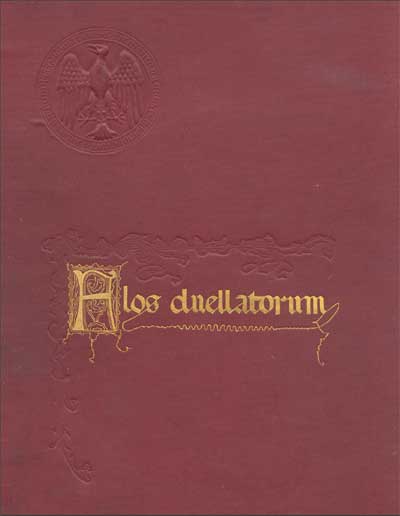 | Fiore dei Liberi Flos Duellatorum, 1410 "Fiore dei Liberi's "Flos Duellatorum", or "Flower of Battle" is a treatise written in Venetian dialect of Italian and was started on Februrary 10, 1409 and completed in six months in late 1409 (1410 using the modern calendar). This version includes a pair of prologs describing the structure of the treatise, and some details of Fiore's life, as well as many illustrations accompanied with short rhyming captions in same Venetian dialect of Italian. Sections on wrestling, dagger, sword, spear, two handed sword, armored combat, pollaxe, and mounted combat, and considerable discussion of disarming techniques. |
 | Renaissance Swordsmanship The Illustrated Use of Rapiers and Cut and Thrust Swords This scholarly, entertaining guide is the most thorough work on Medieval swordsmanship ever undertaken. It was written for advanced and beginning sword enthusiasts, students of military history and martial artists. To write this book the author combined exhaustive research with hands-on practice in fencing, contact-weapon sparring and training with historically accurate replicas. He then illustrated the text with over 100 original drawings depicting authentic Renaissance sword-fighting techniques and how you can use them today. |
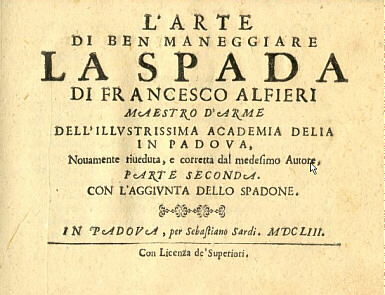 | L'Arte di Ben Maneggiare la Spada, 1653 Francesco Ferdinando Alfieri of Padova was a 17th century master of the Italian school of swordsmanship; according to the title page of La Scherma, he was "Maestro D'Arme" to the Accademia Delia in Padua in 1640. Alfieri's manuscript, written in 1653, describes the basic guards as it pertains to the two-handed sword (from the illustrations, they appear at least 2m long). The manuscript includes textual description of the guards, along with detailed coverage of rapier, rapier & dagger, rapier & cloak. |
 | Old Sword-Play The Systems of Fence Here are sword techniques of the sixteenth, seventeenth, and eighteenth centuries for everyone. Hutton addresses the common techniques of these periods clearly and in enough detail that someone with even a basic knowledge of fencing can follow him. The two-handed sword, rapier and dagger, broadsword and buckler, rapier and cloak, dagger and cloak, the case of rapiers, and a variety of techniques for disarming a swordsman are described in detail. |
 | Cold Steel A Practical Treatise on the Sabre, 1889 The sabre, with the rapier and epee, has been the third arm of fencing for centuries, and also served as the major cavalry weapon. The art of fencing with the sabre is significantly different to the delicacy of epee or the thrust of rapier, and this book explains why. Hutton begins by looking at the construction of the sabre and how to hold it. This is followed by an explanation of the different strokes and defences, and how to combine attack and defence. He then progresses to the more advanced art of sabre fencing, and how left-handed swordsmen should fight. The treatment is in considerable detail, and is as relevant today for the sabre fencer as when the book was first published, in 1889. Hurtton's treatise on the sabre continues with the ceremonial aspects of the art. He also looks at sabre against bayonet, and the French sword. There are descriptions of assocaited weapons such as the great stick and the constable's truncheon, and the book concludes with a look at the sword-bayonet, short sword and dagger. There are numerous illustrations in the book, with a total of 55 movement drawing diagrams. |

* [EL] = External Links



4 comentarios:
Aqui falta un tratado español que es uno de los más importantes (si no el que más) de esgrima de su epoca: La Verdadera Destreza (el titulo completo es más largo). de su epoca y actual.
Books in Italian: http://www.achillemarozzo.it/pubblicazioni/pubblicazioni.php
Ehi download Facsimile of the Pisani-Dossi version of Flos Duellatorum MS by Francesco Novati (PDF file, 42M).
http://mac9.ucc.nau.edu/novati/novati.pdf
Vale, ok, añadidos links externos que duraran lo que duren... ^^U
Publicar un comentario