
La heráldica es la ciencia del blasón (Blasón, según la RAE se define como el «Arte de explicar y describir los escudos de armas de cada linaje, ciudad o persona.»). Es también un campo de expresión artística, un elemento del derecho medieval y de las dinastías reales hasta nuestros días. Más recientemente, ha sido admitida dentro de las ciencias anexas de la historia junto con la sigilografía, la vexilología, la falerística y la diplomática.
La heráldica se desarrolló durante la Edad Media en toda Europa hasta convertirse en un código coherente de identificación de personas, progresivamente incorporado por estamentos de la sociedad feudal como la nobleza y la Iglesia Católica para la identificación de linajes y miembros de la jerarquía, siendo igualmente adoptado por otros colectivos humanos, como gremios y asociaciones, además de ser adoptado para la identificación de ciudades, villas y territorios.
La heráldica se desarrolló durante la Edad Media en toda Europa hasta convertirse en un código coherente de identificación de personas, progresivamente incorporado por estamentos de la sociedad feudal como la nobleza y la Iglesia Católica para la identificación de linajes y miembros de la jerarquía, siendo igualmente adoptado por otros colectivos humanos, como gremios y asociaciones, además de ser adoptado para la identificación de ciudades, villas y territorios.

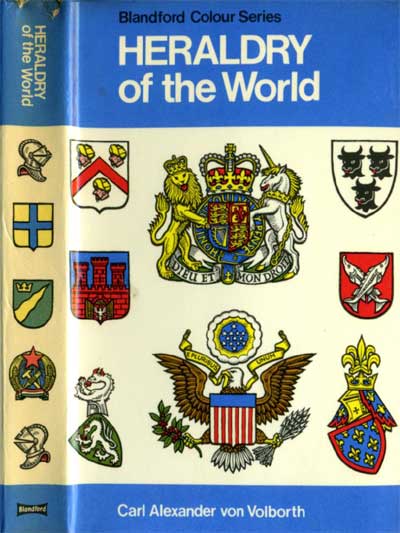 | Heraldry of the World The book is devoted to heraldry and talks about its basic concepts. |
 | A Complete Guide To Heraldry A Complete Guide to Heraldry by Arthur Charles Fox-Davies (1871-1928) was originally published in 1909 by T.C. & E.C. Jack. The work has since passed through countless editions and remains in print more than 80 years after its author’s death. That alone could be testament enough to this book’s influence on the lay-person’s study of heraldry. Greater still however is the art the book contains from Graham Johnston, Herald Painter to the Lyon Court. Johnston’s heraldic drawings have become the standard by which modern heraldic devices are measured and a great number of the traditional heraldic depictions seen on the internet today are in fact Graham Johnston’s work, which unfortunately is most often not attributed. The style Fox-Davies uses in constructing his Complete Guide to Heraldry is far from concise, as the text is presented in an often rambling and hap-hazard method. To the serious student of heraldry who braves the tomes 600+ pages will find the result most satisfactory, for in whole, Fox-Davies confers a deeper and wider knowledge of the art of heraldry than could ever be broached in a more ‘concise’ work. |
 | Simple Heraldry Alternately known as Simple Heraldry Cheerfully Illustrated, this little British book was a delight of my teens and twenties; I read it repeatedly out of my local library during those years. Now I've acquired a copy of my own, and it's lost none of its charms. Moncreiffe (and Pottinger, who, although he seems to be billed on the jacket as co-author, is acually the illustrator) gives us an easily understandable, humorously illustrated look at the whole system and science of heraldry, beginning with the why of it ("A man in full armor was unrecognizable") and going on to show the elements of an "achievement" (the whole family device, supporters, motto, and all), the ways in which wives, daughters, and sons differentiate it, how other entities than individuals (everything from realms to corporate bodies) can use coats of their own, and the rules attendant upon description--colors, charges, partitions, and other devices. Anyone who needs to understand the basics of this field can't do better than to begin with Moncreiffe. |
 | An Heraldic Alphabet A most useful dictionary of heraldry and heraldic terms. Those with a casual interest in the subject will find the comprehensive descriptions helpful and will be able to acquire the language of heraldry through them. But the serious student too will find this a useful reference book |
 | English Heraldry Descriptions and explanations which surround Family Crests, Coats of Arms, and their relationship to history are validated in this wonderful addition to the genealogist’s bookshelf. Four hundred and fifty illustrations were drawn with countless hours spent engraving the designs on wooden blocks for printing in this meticulous reference, which has been a source of documentation for over 140 years! |
 | Heraldry, Pageantry and Social Display in Medieval England Medieval culture was intensely visual. Although this has long been recognised by art historians and by enthusiasts for particular media, there has been little attempt to study social display as a subject in its own right. And yet, display takes us directly into the values, aspirations and, indeed, anxieties of past societies. In this illustrated volume a group of experts address a series of interrelated themes around the issue of display. Among the themes are family and lineage, social distinction and aspiration, ceremony and social bonding, and the expression of power and authority. The objects studied include monumental effigies, brasses, stained glass, rolls of arms, manuscripts, jewels, plate, seals and coins. |

* [NL] = No Links



4 comentarios:
Interesante, aunque uno sobre heráldica española no estaria mal
Sí, con el vocabulario tan específico que utiliza la heráldica, es difícil traducir del inglés al español.
Bueno, yo pensaba que tenia un tratado en castellano, pero no lo doy encontrado, no se de donde saque esa idea... todavia lo estoy buscando, si lo encuentro lo subo, tranquilos.
¡Gracias!
Publicar un comentario