
En un dia como hoy, hace 70 años, empezo la Operacion Overlord, el comienzo de la invasion aliada de la europa ocupada nazi. Dicha operacion involucraba al grueso de los ejercitos estadounidense e imperial britanico, apoyados por tropas auxiliares francesas, polacas y de otras nacionalidades, para asaltar las playas de Normandia por medio de desembarcos anfibios, desarrollandose desde el 6 de junio (Dia D) hasta el 25 de agosto, en que se libero Paris.

Fue la costa de Normandia la que se eligio para crear una cabeza de playa, que se dividio en cinco zonas de ataque (Utah, Omaha, Gold, Juno y Sword), y que por sus caracteristicas y defensas, se sabia que iba a ser una toma sangrienta. El Muro Atlantico se alzaba ante ellos, repleto de artilleria y nidos de ametralladora, guarnecidos en bunkers.
La batalla mas importante de la operacion Overlord fue el propio desembarco, que realmente comenzo en la madrugada del 6 de junio de 1944 con el despliege, detras de la linea defensiva alemana, de unidades aerotransportadas americanas y britanicas, que impidieron la rapida llegada de los refuerzos alemanes cuando comenzo el desembarco en si.
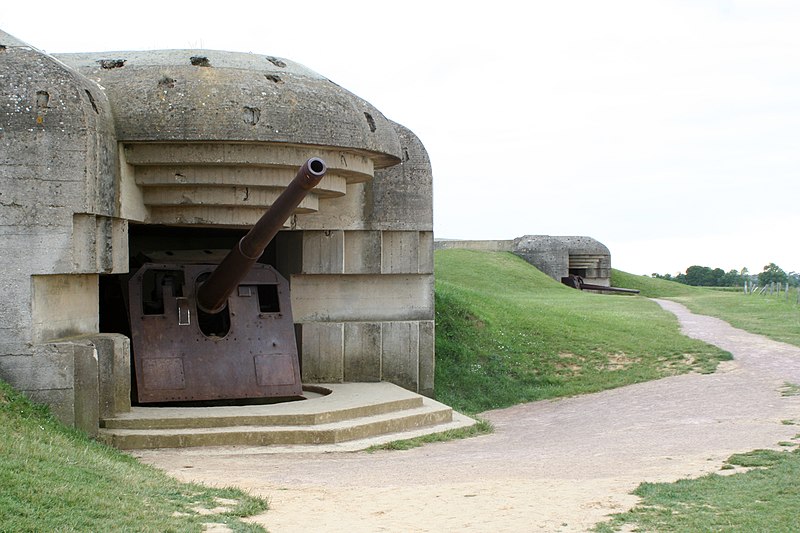
Cuando comenzo el desembarco, las dificultades de navegacion de las lanchas de desembarco fueron el primer problema que se encontraron las tropas, ya que no consiguieron en muchos casos alcanzar su objetivo. Las tropas destinadas a Utath se vieron desplazadas un kilometro de su objetivo, que en cierta manera les ayudo a tomarlo con mas facilidad, al llegar a un sitio con menos defensas de las esperadas. Los otros objetivos fueron, dentro de las estimaciones que se tenian, faciles de tomar...
Solo la playa Omaha fue la mas dificil -y sangrienta- de tomar, ya no solo por los acantilados rocosos y sus puestos fortificados con nidos de ametralladora y artilleria, sino por la mala suerte de encontrarse en la zona una division alemana de entrenamiento. La toma de la playa le costo a los americanos 6000 muertos y 15000 heridos.
Los siguientes dias, del 7 al 18 de junio, se consolido la cabeza de playa y se formo un frente continuo, con varias poblaciones tomadas, y repeliendo exitosamente un contraataque aleman. Los avances, sin embargo, fueron excasos, debido a la fuerte resistencia alemana y las caracteristicas de la propia zona, llena de setos, muros y carreteras angostas.
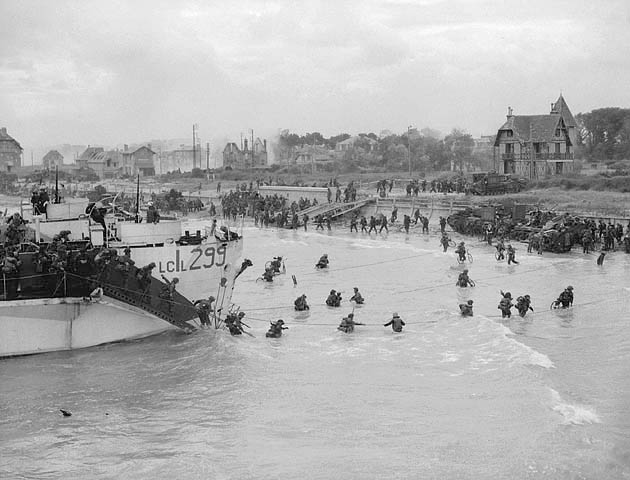


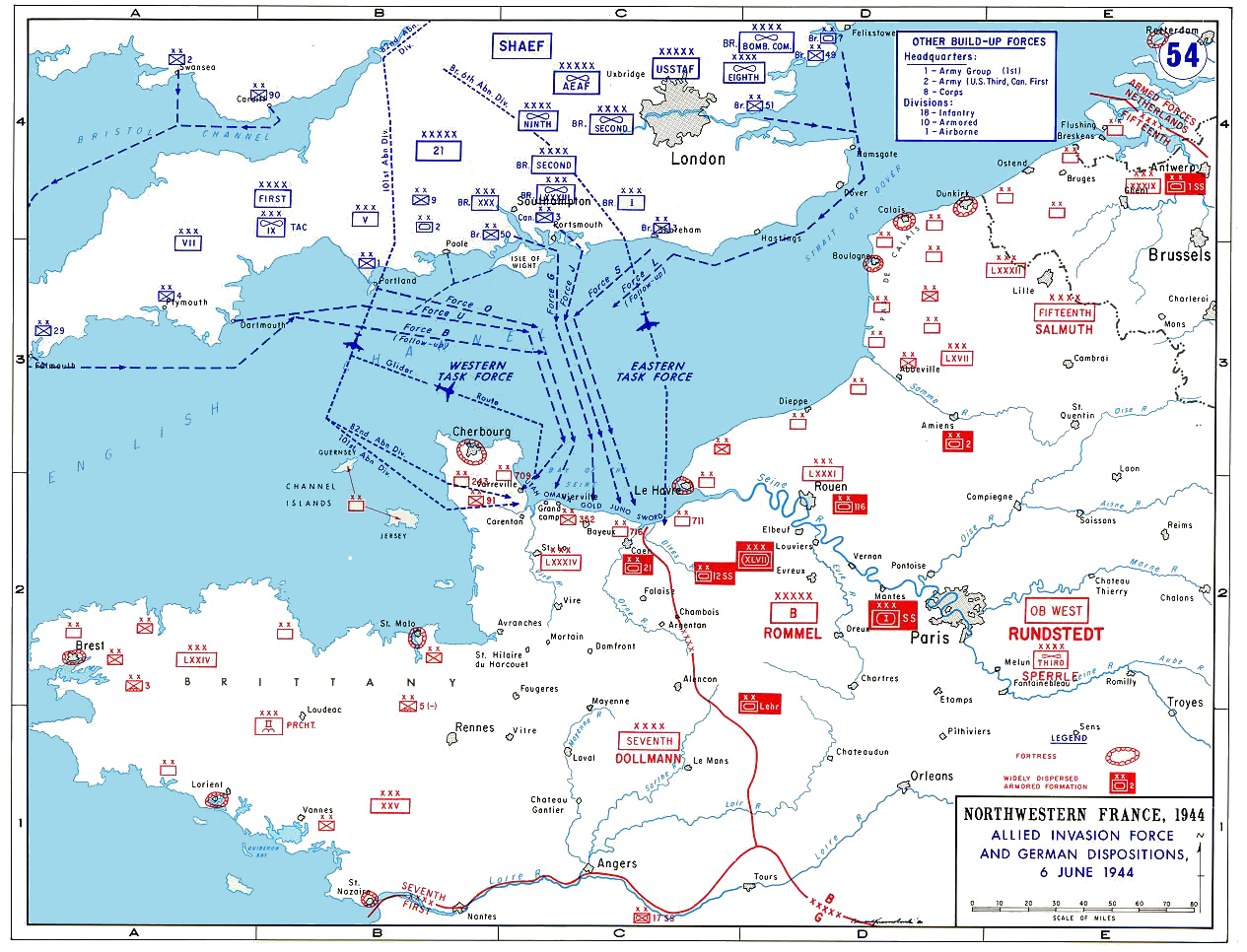
La batalla mas importante de la operacion Overlord fue el propio desembarco, que realmente comenzo en la madrugada del 6 de junio de 1944 con el despliege, detras de la linea defensiva alemana, de unidades aerotransportadas americanas y britanicas, que impidieron la rapida llegada de los refuerzos alemanes cuando comenzo el desembarco en si.
Solo la playa Omaha fue la mas dificil -y sangrienta- de tomar, ya no solo por los acantilados rocosos y sus puestos fortificados con nidos de ametralladora y artilleria, sino por la mala suerte de encontrarse en la zona una division alemana de entrenamiento. La toma de la playa le costo a los americanos 6000 muertos y 15000 heridos.
Los siguientes dias, del 7 al 18 de junio, se consolido la cabeza de playa y se formo un frente continuo, con varias poblaciones tomadas, y repeliendo exitosamente un contraataque aleman. Los avances, sin embargo, fueron excasos, debido a la fuerte resistencia alemana y las caracteristicas de la propia zona, llena de setos, muros y carreteras angostas.
 |
Overlord
D-Day and the Battle for Normandy 1944 The famous D-Day Landings of 6 June 1944 marked the beginning of Operation Overlord, the battle for the liberation of Europe. Max Hastings has overturned many traditional legends to write this memorable study. Drawing together the eyewitness accounts of survivors on both sides, plus a wealth of previously untapped sources and documents, Overlord provides a brilliant, controversial perspective on the devastating battle for Normandy. 'A masterly book, rich in insight, shrewd and weighty in judgement . . . Max Hastings stands in the first rank of writers on modern war' Financial Times 'A book which combines serious historical and critical comment with brilliant reportage. He brings both the arguments between higher commanders and the fighting on the battlefield itself to life more vividly than previous books' Times Literary Supplement 'A beautifully written masterpiece which makes The Longest Day seem inadequate' Len Deighton. |
 |
El Dia D
La Batalla de Normandia El genial escritor Antony Beevor vuelve a maravillarnos con su narración del Día D. Tras largos años de trabajo en archivos que sus predecesores no pudieron consultar (más de treinta, en media docena de países), ha escrito lo que nos parece una obra total sobre la experiencia de la guerra: los preparativos de la invasión de Normandía por las fuerzas aliadas, la disciplinada resistencia de los soldados alemanes, el enfrentamiento, terrible, en las cabezas de playa, el penoso avance en territorio francés con batallas tan fieras como las que se libraban en el frente oriental, el calvario de los civiles franceses masacrados por ambos bandos, las miserables disensiones entre los jefes militares, o la visión, casi insoportable, de la exacción más terrible de la guerra: los heridos, los desnudos y los muertos. |
 |
D-Day Companion PB
Leading Historians explore history's greatest amphibious assault Soldiers, sailors and airmen of the allied expeditionary force: You are about to embark upon the great crusade, toward which we have striven these many months. The eyes of the world are upon you. The hope and prayers of liberty-loving people everywhere are with you ...
General Dwight D. Eisenhower, 1944
Published to commemorate the 65th anniversary of the Normandy Landings, The D-Day Companion book brings together the perspectives and opinions of leading military historians from both sides of the Atlantic. Operation Overlord saw the Allied Generals Eisenhower and Montgomery pit their wits against Hitler in a bold bid to liberate continental Europe. Featuring a foreword by Major Richard Winters, real-life commander of Easy Company as featured in Stephen E Ambrose's Band of Brothers, this is a unique and incisive examination of the momentous events that surrounded June 6, 1944. Each chapter of this book focuses on a different aspect of the D-Day landings, from the build-up to the attack to the experiences of the troops on the ground. |
 |
The Longest Day
The Classic Epic of D-Day The Longest Day is Cornelius Ryan's unsurpassed account of D-Day, a book that endures as a masterpiece of military history. In this compelling tale of courage and heroism, glory and tragedy, Ryan painstakingly recreates the fateful hours that preceded and followed the massive invasion of Normandy to retell the story of an epic battle that would turn the tide against world fascism and free Europe from the grip of Nazi Germany. This book, first published in 1959, is a must for anyone who loves history, as well as for anyone who wants to better understand how free nations prevailed at a time when darkness enshrouded the earth. |
 |
Normandy
The Landings to the Liberation of Paris The Allied landings on the coast of Normandy on June 6, 1944, have assumed legendary status in the annals of World War II. But in overly romanticizing D-day, Olivier Wieviorka argues, we have lost sight of the full picture. Normandy offers a balanced, complete account that reveals the successes and weaknesses of the titanic enterprise. In addition to describing the landings with precision and drama, Wieviorka covers the planning and diplomatic background, Allied relationships, German defensive preparations, morale of the armies, economics and logistics, political and military leaders, and civilians’ and soldiers’ experience of the fighting. Surprisingly, the landing itself was not the slaughter the general staff expected. The greater battle for Normandy—waged on farmland whose infamous hedgerows, the bocage, created formidable obstacles—took a severe toll not only in lives lost, but on the survivors who experienced this grueling ordeal. D-day, Wieviorka notes, was a striking accomplishment, but it was war, violent and cruel. Errors, desertions, rivalries, psychological trauma, self-serving motives, thefts, and rapes were all part of the story. Rather than diminishing the Allied achievement, this candid book underscores the price of victory and acknowledges the British, American, and Canadian soldiers who dashed onto the Normandy beaches not as demigods, but as young men. |
 |
D Day: June 6, 1944
The Climactic Battle of World War II Stephen E. Ambrose draws from more than 1,400 interviews with American, British, Canadian, French, and German veterans to create the preeminent chronicle of the most important day in the twentieth century. Ambrose reveals how the original plans for the invasion were abandoned, and how ordinary soldiers and officers acted on their own initiative. |
 |
Normandy Omaha Beach
V Corps Battle for the Beachead This book guides the reader through the battle for the V Corps beachhead, the fiercest and bloodiest of the Landings. Events from the early stages of planning Operation Neptune-Overlord through to the battles between 6 to 8 June 1944 are examined. |
 |
Utah Beach
The Amphibious Landing and Airborne Operations on D-day, June 6, 1944 Although the assault on Utah Beach ultimately became one of the most successful military operations of World War II, its outcome was anything but certain. Not only was Utah the most isolated of the five D-Day beaches, but the airborne assault was of unprecedented size and complexity. Despite the perils, American troops confidently cascaded into that far corner of Normandy and contributed decisively to the Allied triumph on D-Day. With verve and authority, Balkoski describes how that victory was won. |
 |
Gold Juno Sword
On 6th June 1944, the Allied armies won a glorious victory in the battle of the Normandy beaches, the first phase of the Allied plan for the liberation of Europe from the northwest, Operation Overlord. Here, at last, is an illustrated hour by hour account of the D-Day landings in the British sector, from Asnelles to Ouistreham: The German defensive troops and the Atlantic Wall; The British and Canadian troops which assaulted the beaches; Weapons, equipment and tactics; The personalities: Major General Rennie, Lord Lovat, Major General Keller, Major General Graham; The Canadian advance on Juno; The British Sector after D-Day: consolidation on June 7th and 8th. |
 |
D-Day: Juno Beach
Canada's 24 Hours of Destiny Many have called it the most important event of the twentieth century - and Canada played a key role. When Canadian troops landed at Juno Beach, they faced some of the fiercest opposition of the attack, and yet they managed to advance further inland than all the other Allied forces. D-Day: Juno Beach, Canada's 24 Hours of Destiny chronicles that momentous day hour-by-hour, through the words of the men themselves. With more than 300 illustrations, this is a vivid remembrance of one of Canada's greatest military achievements. |
 |
Cracking Hitler's Atlantic Wall
The 1st Assault Brigade Royal Engineers on D-Day Landing with the British and Canadians in Normandy on D-Day, June 6, 1944, was the 1st Assault Brigade Royal Engineers, a specialised armoured unit tasked with removing obstacles and mines from Gold, Juno, and Sword Beaches. To support this mission, the engineers modified their tanks with ingenious innovations, such as replacing the main gun with a giant mortar or attaching a steamroller-like device to flatten a path in the sand. In the early hours of D-Day, the brigade landed under fire, took serious casualties in some areas, but achieved many of its key objectives and cleared the way for the infantry. |
 |
D-Day 1944
Air Power Over the Normandy Beaches and Beyond June 6,1944 Operation Overlord, the Normandy invasion - like William the Conqueror's before it or the Inchon landing afterwards - will long be studied as a classic in military planning, logistics, and operations. Overlord depended to a remarkable degree upon the use of air power in virtually all its forms. A half-century ago, aircraft were primitive vehicles of war compared to the modern attackers of the Gulf War era, with their precision weapons, advanced navigational, sensor systems, and communications. Yet, the airplane still had a profound impact upon the success of the invasion. Simply stated, without air power, Normandy would have been impossible. |
 |
D-Day RAF
The RAF's Part in the Great Invasion It was the largest seaborne invasion in military history but D-Day could not have happened without the Royal Air Force. When the dramatic events of June 6, 1944, are retold the courage of British and Commonwealth pilots and aircrew is seldom mentioned - yet the dangerous missions they flew were vital to Operation Overlord’s success. The author recounts stories of quiet bravery and individual heroism high above the blood-soaked beaches and landing grounds of France, illustrated with rare period photographs. D-Day RAF: The RAF’s Part in the Great Invasion presents the very human face of the air force's role in the Normandy landings, and looks in detail at the types flown in support of them, from Supermarine Spitfire fighters and Hawker Typhoon fighter-bombers to A-20 Boston and Avro Lancaster bombers. D-Day RAF: The RAF’s Part in the Great Invasion written by retired squadron leader and Battle of Britain Memorial Flight commanding officer Clive Rowley. This eBook may not contain every illustration used in our print or digital replica editions. |
 |
Voices from D-Day
Eyewitness Accounts from the Battle for Normandy The extraordinary and compelling story of the 6th of June, 1944, Operation Overlord and the Battle for Normandy is told here through first-hand testimonies from civilians and soldiers on both sides. It features classic accounts by soldiers such as Rommel and Bradley, together with frontline reports by some of the world's finest authors and war correspondents, including Ernest Hemingway and Alan Melville. Highlights of this unique collection include the break-out from Omaha beach as told by the GI who led it, a French housewife's story of what it was like to wake up to the invasion, German soldiers' accounts of finding themselves facing the biggest seaborne invasion in history, a view from the command post by a member of Eisenhower's staff, combat reports, diaries and letters of British veterans of all forces and services, and accounts of the follow-up battle for Normandy, one of the bloodiest struggles of the war. The Allied armada involved over 5,000 craft, which had by the end of 'the longest day' succeeded in landing 156,000 men, and in breaching Hitler's much vaunted defensive wall. Dramatic and historic though the events of D-Day were, they were but the opening shots of a much larger and equally remarkable battle - the battle for Normandy. It took the Allies ten weeks of bloody fighting to get out of Normandy, during which the infantry casualty rate rivalled that of the Western Front in the First World War. This book is the story of that fateful day, the preparations which led up to it, and the ten weeks of fighting in Normandy which followed it, told by the men and women who were there, who witnessed it at first hand. It is compiled from interviews with scores of veterans, from diaries, memoirs and letters. Occasionally, exact chronology has been sacrificed in the interests of communicating better the experience of Normandy, for above all this is a book about how the invasion looked and felt to those who were there. It is often brutally honest, far removed from the comfortable romantic version of D-Day and the battle for Normandy. For example, there are accounts here of crimes committed against German POWs by Allied soldiers. |
 |
Forgotten Voices of D-Day
A Powerful New History of the Normandy Landings in the Words of Those Who Were There The definitive oral history of the single-day invasion that proved to be the turning point of World War Two — D-Day. June 6, 1944 — one of the most momentous days in history: the day when Allied forces invaded Nazi-occupied Europe. Under the command of U.S. General Dwight Eisenhower, the Normandy landings were the culmination of three years’ planning and the most ambitious combined amphibious and airborne assault ever attempted. Its success marked the beginning of the end for Nazi Germany. Drawing on the Imperial War Museum’s vast Sound Archive, Forgotten Voices of D-Day tells the full story of this turning point of the war. From the build up in Britain of a vast invasion force, to the deception measures taken to try to fool the Germans into believing the invasion would take place elsewhere. Featuring remarkable, often untapped first-hand testimonies, Forgotten Voices of D-Day is the definitive oral history of a defining turning point in history. |
 |
Fortress Europe
Hitler's Atlantic Wall Once it became apparent that German military ambitions in the west were to be thwarted by British resistance and Hitler's attention turned to the greater goal of the defeat of Stalin's Russia, the need to shore up the defense of Europe against any possible attack from the British Isles became imperative. Although earlier phases of the war had proved the ineffectiveness of fixed defensive lines- most notably in the failure of the French Maginot Line -the concept of an Atlantic Wall was central to German defensive plans in the west. Stretching along the Atlantic and Channel coasts, a complex network of fortifications was constructed, a network that was to have a dramatic impact on the Allied strategic planning for D-Day in June 1944. Although the Atlantic Wall was to fail its ultimate test, along certain sections of the coast the German defenses were able to impose massive casualties on the invasion force; if the German support forces had been able to reach the Allied beachhead more rapidly, the history of the war might have been fundamentally different. A book devoted to the construction, manning and defence of Hitler's Atlantic Wall, largely from the German viewpoint, and covering such issues as how far the French resistance stifled construction and sabotaged materials. |
.jpeg) |
The Atlantic Wall
France In 1942, with Germany's gradual loss of the strategic initiative to the Allies, Hitler was forced to construct an impenetrable wall of fortifications along the Atlantic and Mediterranean coast. However, Hitler's grandiose Atlantic wall scheme was hampered by the realities of Germany's wartime economy. Without the resources and manpower to fortify the entire coast, the emphasis was placed on the great festung ports, the likely location of an Allied amphibious landing. This first volume in a series of three deals solely with the structures on the French Atlantic coast starting with the Pas de Calais and extending down to Spain. Featuring detailed illustrations and diagrams of the various sections of the Atlantic Wall and the role that they played, it gives an insightful analysis into some of the most accessible fortifications of World War II. |
.jpeg) |
The Atlantic Wall
Belgium, The Netherlands, Denmark and Norway Germany's Atlantic Wall was the most ambitious military fortification program of World War II. Following its conquest of Western Europe, Germany had to defend some 5,000km of Atlantic coastline from the Spanish border to the Arctic Circle. The United States' entry into the war and the inevitability of an Anglo-American landing in Western Europe resulted in the fortification of this coastline along its entire length. Focusing on the northern Atlantic Wall in the Low Countries and Scandinavia, this title addresses the special defensive features and unique aspects of fortification in these countries, such as the early focus on fortifying Norway, due to early British commando raids; the greater use of turreted naval guns; and, the establishment of first-line Flak defences in the Low Countries to counter the Allied strategic bombing campaign. |
 |
The Channel Islands, 1941-45
Hitler's Impregnable Fortress During World War II, the Germans occupied the undefended Channel Islands from the end of June 1940 until the end of the war, creating a series of defensive positions that was considered the strongest stretch of the Atlantic Wall. The Channel Islands fortifications can be seen as the pinnacle of German engineering during the war. This book describes the design, construction and manning of these defensive positions, as well as the occupation of the Channel Islands by the Germans. It also explores the living conditions on the islands, the only part of Great Britain to be occupied by the Nazis, through to the liberation of the Islands by the Allies. |
 |
D-Day Fortifications in Normandy
The coastal defenses in Normandy along the D-Day beaches were less thorough than other Atlantic Wall defenses, such as the Pas de Calais, where the Germans expected the main attack. However, they still proved to be formidable obstacles for the Allied invasion force. Rommel stressed the need to defeat the invasion on the beach, and therefore the Normandy beach fortifications took on a significant role in German tactical thinking. This book covers the different levels of passive and active fortifications that were designed to stop the Allied assaults on the beaches of Normandy. |
 |
Guns on the Atlantic Wall, 1942-1945
This book covers the guns that were emplaced along the Atlantic Wall by Germany during WWII. |
Links de la entrada externos al blog. No sabemos durante cuanto estaran disponibles.
Los sospechosos habituales los podeis encontrar en el Depot.
Los sospechosos habituales los podeis encontrar en el Depot.




No hay comentarios:
Publicar un comentario